Walk First Avenue past 43rd Street on a weekday evening and you'll pass a chain-link fence, then, a few hundred feet later, an open gate. Behind the fence: a pier that's been closed to the public since Bush Terminal stopped moving freight decades ago, now mid-transformation into parkland. Through the open gate: a public park that's been welcoming soccer leagues and dog walkers since 2014. Both sit on land that used to belong to the same industrial complex. Only one of them is finished.
That gap, between what's already open on this stretch of Sunset Park's waterfront and what's still fenced off, is about to get stranger before it gets simpler. Sometime in late 2026, a 1,000-person concert and arts venue is scheduled to open a few hundred feet from that fence, inside a building on the same campus as the unfinished pier. The people who live nearest to it will be able to walk to a show before they can walk onto the water the venue looks out toward. The sequencing is backward from how these things usually go, and it's worth understanding both halves if you're the one who'll be navigating this corridor over the next year.
Two Campuses, One History
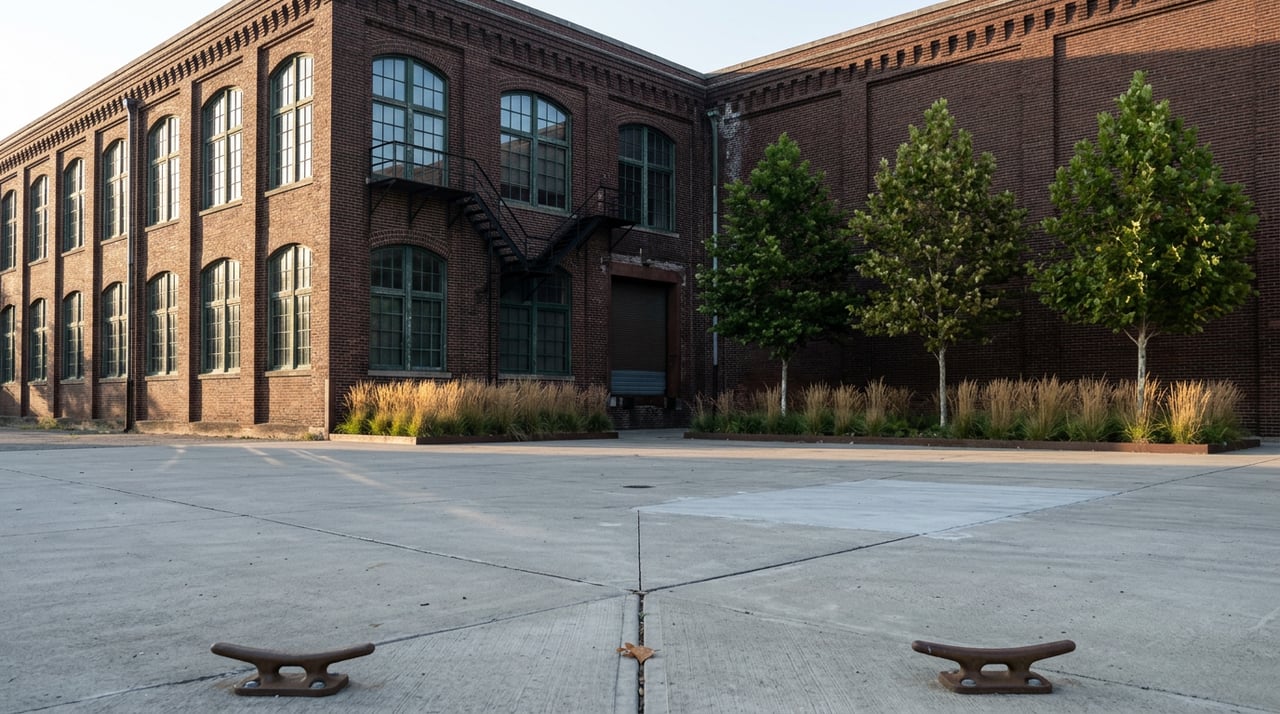
Most people who've watched Sunset Park's waterfront change over the past decade think of it as one thing: Industry City. It isn't. Industry City, the 35-acre creative and manufacturing campus between 32nd and 41st Streets, is privately owned, run by a consortium that includes Jamestown. South of it, between roughly 40th and 51st Streets, sits MADE Bush Terminal, a twenty-acre campus that the city, through the New York City Economic Development Corporation, owns and operates directly. Both trace back to the same Bush Terminal Railroad Company complex built in the late 1800s. Only one answers to a private consortium's leasing timeline. The other answers to city budgets, city procurement rules, and city construction schedules, which is a large part of why the two campuses are moving at such different speeds right now.
MADE Bush Terminal currently holds 140,000 square feet of manufacturing space and 30,000 square feet set aside for cultural and public programming, alongside five acres of parkland already delivered elsewhere on the campus. That's the baseline. What's coming next is where the story gets interesting.
The Venue Gets There First
In December 2025, NYCEDC announced it had partnered with Public Service, the creative studio behind Gowanus's Public Records, to build a new music and arts venue inside Building A's ground-floor annex at MADE. The space, which hasn't been named yet, will seat 1,000 people and is being designed by nARCHITECTS, the firm behind MADE's broader campus redesign, with Arup handling acoustics. Some of the same people who built Public Records' sound system, including NNNN and Devin Turnbull of Ojas, are returning for this one. The building itself isn't new to hosting a crowd. The Architectural League held its Beaux Arts Ball there in October 2025, inside what was still an industrial warehouse annex.
Public Records co-founder Shane Davis has been clear that this isn't a copy-paste expansion.
"There will never be another Public Records."
What it will be, according to NYCEDC vice president Waverly Neer, is something broader than a nightclub calendar. Alongside ticketed live music and large-scale art installations, the venue is expected to host local high school graduations, food and toy drives, health screenings, and ESL classes. That's a wider mandate than most performance spaces take on, and it reflects the same public-private structure that separates MADE from Industry City next door: NYCEDC owns the building, but a private operator runs the programming, with a stated goal of the space functioning as neighborhood infrastructure as much as entertainment.
The venue is slated to open in late 2026. That's now a matter of months, not years.
The Pier That's Still Behind the Fence
Pier 6 sits just west of Building A, and it's the reason the fence is still up. NYCEDC broke ground on the five-acre pier in August 2025, backed by a $25 million construction budget and a design team led by SCAPE Landscape Architecture, with Arcadis, Matrix New World, Sam Schwartz Engineering, Johnson & Asberry, and JK Muir rounding out the project. The plan calls for lawns, a tidal pool, and what SCAPE describes as a coastal forest, built around a stretch of pier that's spent the past sixty years unused, developing its own self-seeded tree cover in the process. Historic industrial elements, including old bollards, are being reused rather than removed.
Once finished, Pier 6 will open a section of Sunset Park's waterfront to the public for the first time in decades. It will also double the amount of dedicated public open space on the MADE campus, from the five acres already delivered to ten. NYCEDC has stated that construction is expected to wrap in 2027.
At the groundbreaking, Kathy Park Price of New Yorkers for Parks connected the project to a specific local reality: Sunset Park has less park space per capita than much of the city and one of its higher childhood asthma rates, which is part of why she called Pier 6 an investment in public health, in climate resilience, in our workforce and in the social fabric of Sunset Park. That framing matters here because it explains why this particular pier, on this particular five-acre footprint, has taken on more weight than a simple landscaping project. It's also why the timeline can't be rushed the way a private developer might rush a retail buildout. Stabilizing a pier that's been eroding since the 1970s and remediating decades of industrial use takes longer than fitting out a warehouse annex for concerts.
NYCEDC also has an open request for proposals covering an anchor food and beverage concession in the campus's Café Building, with responses due back in January 2026. Whether that produced a signed tenant hasn't been made public. A future ferry landing is part of the same long-range plan, though it remains unscheduled.
What's Already Open While You Wait
None of this means the waterfront here has been closed the whole time. Bush Terminal Piers Park, a separate, already-completed park next to the Pier 6 site, has been open since 2014. Run by NYC Parks rather than NYCEDC, its just over 22 acres stretch along First Avenue roughly between 43rd and 51st Streets, with two multi-purpose soccer and baseball fields, a nature preserve, tidal ponds, and an esplanade with harbor views. It's open daily from 7 a.m. to 7 p.m., no ticket or reservation required. If you want a sense of what Pier 6 will eventually feel like, this neighboring park is the closest working preview: the same coastline, the same industrial-to-public transformation, just finished more than a decade earlier and under a different agency's care.
That's the part of the story worth sitting with. Sunset Park hasn't been locked out of its own waterfront this entire time. One section has been open and in daily use for over a decade. It's the specific five-acre footprint at MADE that's still behind a fence, and it happens to be the same footprint where a 1,000-person venue is about to open first.
What This Actually Means Over the Next Year
For anyone living within walking distance of this stretch, the practical version is simple. Through the rest of 2026, expect an active construction site at Pier 6 running alongside a brand-new performance venue drawing its first crowds inside Building A. Bush Terminal Piers Park stays your reliable option for fields, the esplanade, and harbor views in the meantime. By 2027, if the current schedule holds, the fence comes down and the campus's public open space doubles, connecting a finished pier to a venue that's already been running shows for a year.
It's an unusual way for a waterfront to come back to a neighborhood, cultural programming ahead of the physical ground it's meant to sit beside. Most projects like this open the park first and build anticipation for what comes next. Sunset Park is getting it in the other order, and knowing which piece arrives when is the difference between showing up in November wondering why the water's still fenced off, and knowing exactly what you're looking at.
If you're watching this corridor because you own property nearby, or you're thinking about what a finished waterfront district does to the surrounding blocks, that's a conversation worth having with someone who tracks this market closely. The CS Organization works across South Brooklyn every day, and we're happy to talk through what projects like this tend to mean for the neighborhoods around them.